How to read a GI tag (and why it matters)
A short primer on what a Geographical Indication actually protects — and what it doesn't.
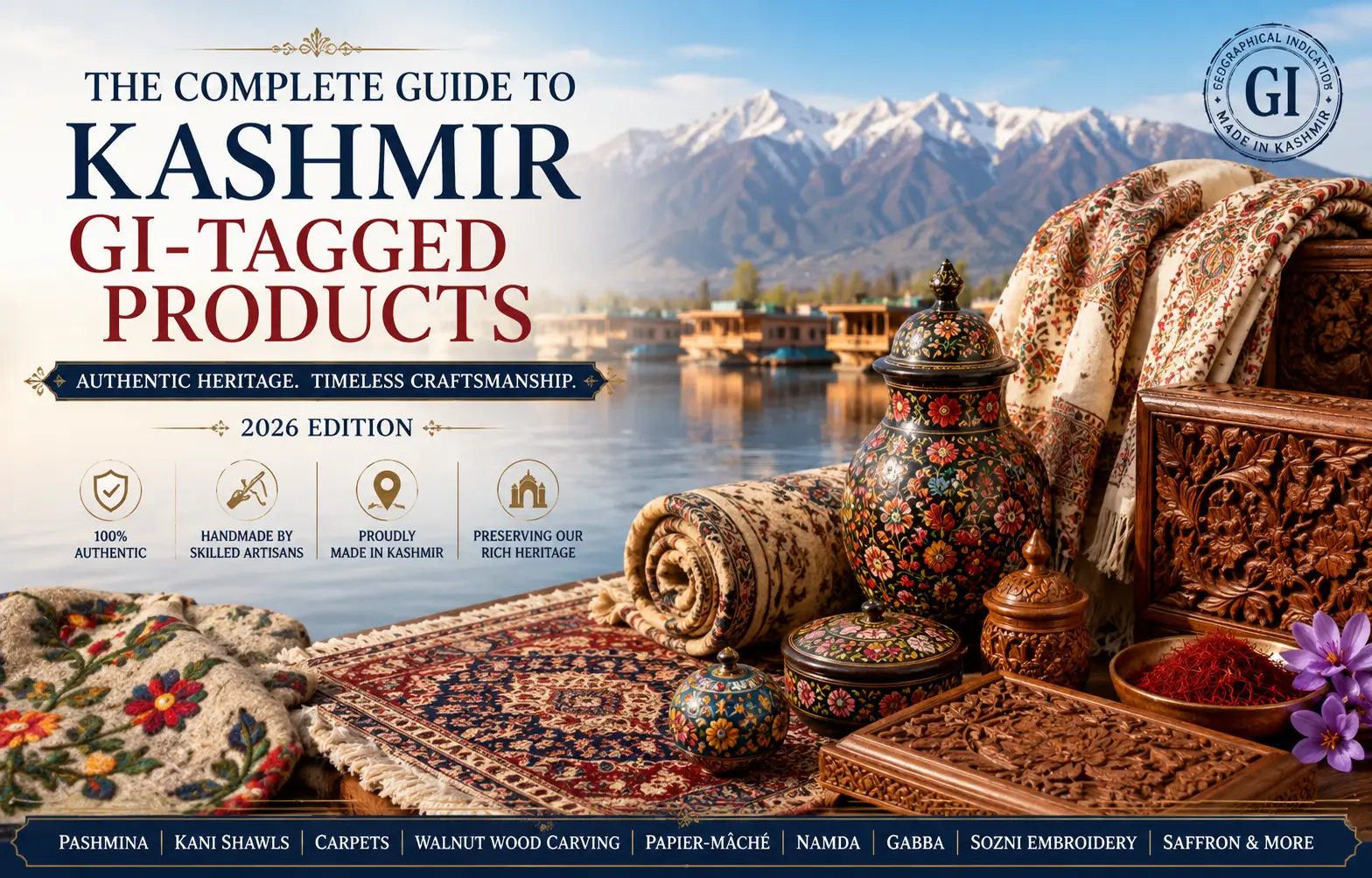
You'll see four letters and a number on the tax invoice of an authentic Kashmir Pashmina shawl: GI-46. On Pampore saffron, it's GI-635. On Walnut Wood, GI-176.
This short note explains what these numbers actually mean — and the two big things they don't mean.
What a GI tag is
A Geographical Indication is a Government of India certificate, issued under the GI Act of 1999, that legally restricts a product name to its place of origin. Once "Kashmir Pashmina" is GI-registered, only pashmina that was hand-spun, hand-warped, hand-woven and hand-finished inside the Kashmir valley can legally be sold under that name.
It's the same legal mechanism that protects Champagne, Parma ham and Darjeeling tea.
What the tag protects
Three things:
- The name. No one outside the registered region can call their product "Kashmir Pashmina" or "Pampore Saffron". It's enforceable in court.
- The process. The GI specification spells out how the product must be made. For pashmina, that means hand-spinning is mandatory. For walnut wood, that means the wood must come from valley trees.
- The maker community. Authorised users — usually a cooperative or registered artisan body — control who's allowed to issue the tag. It puts the money back in the maker community's hands.
What it doesn't protect
Two things people often assume:
- Quality grade. A GI-tagged Mongra saffron and a GI-tagged Lacha saffron are both authentic, but their crocin content (and price) differ substantially. The GI confirms origin and process, not premium grade.
- The fibre or material itself. Cashmere from Mongolia and Iran can still be sold — it just can't be called "Kashmir Pashmina". The tag is on the name, not the substance.
How to read it on an invoice
A genuine piece carries the GI registration number in two places: on the cooperative's stamped certificate, and printed on the tax invoice itself. If both are absent, the piece may still be authentic — but you have no legal recourse if it isn't.
That's why the GI matters. It moves the burden of trust off the buyer and onto the registry.
About the writer
Kashmir Artisan Journal
Kashmir Artisan Journal Editorial Team is a small editorial collective dedicated to documenting the living traditions of Kashmir—its artisans, crafts, landscapes, and the stories that survive through handmade work. Rather than treating craftsmanship as a product alone, the team approaches every article as a record of memory, skill, and cultural continuity. Their work is built through conversations with shawl weavers, wood carvers, papier-mâché artists, saffron growers, bat makers, and families who have practiced the same craft across generations.
The journal believes that the true value of a Kashmiri craft lies not only in its beauty, but in the hands that shape it, the villages that sustain it, and the history carried quietly through everyday labor. Each feature, artisan profile, and heritage essay is researched with care and written with the intention of preserving voices that are often overlooked in mainstream narratives.
By combining field-based storytelling, historical context, and contemporary documentation, the editorial team seeks to create an enduring archive of Kashmir’s artistic heritage—one that can be read by future generations as well as by readers discovering the Valley for the first time.
Website & Social Media Manager — RESHI RAYEES
The journal’s digital presence is managed by RESHI RAYEES, who oversees the website, editorial publishing, visual presentation, and social media strategy. His work focuses on bringing Kashmir’s artisan traditions into the digital world without losing the authenticity, dignity, and human stories behind each craft. Through careful curation and digital storytelling, he helps connect local makers with audiences across India and around the world.